
The 14-Day Purge: What Google's September 2026 Spam Update Targeted (And Who Got Crushed)
Google has officially confirmed the completion of its September 2026 global spam update on 8 October.
The rollout took 14 days. In a year where previous spam passes in March, June, and August were executed in brief 24-to-48-hour bursts, a two-week deployment signalled a much wider scope. Alongside automated systems re-evaluating site quality, industry trackers noted an aggressive wave of targeted manual action penalties, particularly around site reputation abuse.
Now that ranking volatility has levelled off, SEO and digital marketing teams can finally establish an accurate post-update performance baseline.
If your traffic took a hit between late September and early October, you shouldn't assume it was transient ranking jitter. The data emerging from audited sites shows that Google pulled the floor out from under very specific, scaled tactics
The Real-World Losers: What Google Demoted
Industry analysts Glenn Gabe and Lily Ray tracked ranking drops across multiple verticals during the rollout. The sites that suffered severe visibility losses generally fell into three distinct categories:
1. Synthetic Aggregators & "Mt. AI" Hubs (Case Study: Grokipedia)
One of the most visible casualties tracked by Glenn Gabe was Grokipedia, a massive, AI-generated knowledge base and encyclopedia setup. SEMRush indicates a drop from around 150,000 top 20 rankings to under 4,000 this week.
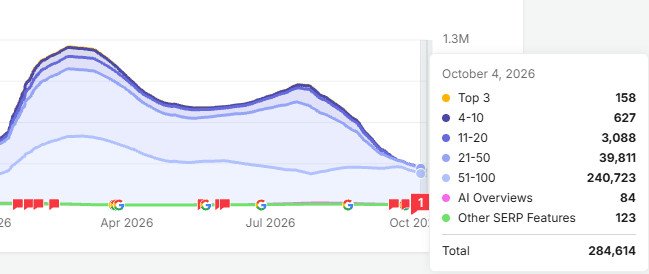
Grokipedia’s rankings… ooooof
Grokipedia had previously seen turbulent surges and drops, but the September update triggered a steep, compounding collapse in search visibility. The domain represents what Gabe categorizes as "Mt. AI": websites publishing millions of synthetic informational pages that rehash existing public web knowledge without introducing proprietary research, fresh entity validation, or unique human insight. Google's automated classifiers treated the sprawling footprint as scaled content abuse, wiping its visibility across commercial and informational queries.
2. Programmatic Directory Traps (The Area Code & Phone Number Farms)
As documented by Lily Ray, the update aggressively targeted sites that mass-produced templated programmatic pages designed to capture granular local searches, such as spinning up separate URLs for every individual phone number, area code, or regional zip code. I remember this being a tactic that was frowned about in the 2010s - so no real surprises here.
These domains pulled publicly available datasets, pasted them into identical boilerplate page structures, and used automation to rank for hundreds of thousands of low-competition long-tail queries. With zero unique user value, zero verified local context, and no actionable features beyond directory links, these programmatic "doorway" networks saw entire page clusters demoted or scrubbed from the index.
3. "Parasite SEO" and Site Reputation Abuse
The update also landed heavy blows on established, high-authority media domains that leased subdirectories or sections of their site to third-party commercial operators. High-DA publishers hosting syndicated commercial directories (such as third-party casino reviews, credit card affiliate hubs, or unreviewed coupon codes) were hit with algorithmic demotions and direct manual penalties. When a site's primary authority is rented out to host off-topic, unreviewed commercial pages, the entire section becomes a direct target for search quality systems.
Why the 14-Day Duration Matters
A typical 48-hour spam update acts like a patch targeting an acute loophole. A 14-day update behaves more like a comprehensive core quality reassessment.
Spam updates adjust Google's automated scoring systems, including SpamBrain. When an automated penalty hits at the domain level, recovery is not a matter of tweaking meta tags or disavowing a handful of links. Historical data shows that recovering from scaled content penalties requires an extensive clean-up process-often taking four to six months of pruning low-value URLs, overhauling thin templates, and waiting for search crawlers to re-evaluate the entire domain.
What to Audit Right Now
If your organic performance dropped over the last two weeks, work through a disciplined audit before making knee-jerk changes:
1. Check Google Search Console for Manual Actions: Open the Security & Manual Actions tab immediately. Ensure your domain was not hit with a direct penalty for site reputation abuse or unnatural outbound links.
2. Isolate Template Volatility: Determine whether the drop is sitewide or isolated to specific page types. If your core editorial content is holding steady but programmatic landing pages collapsed, the issue is template quality, not domain trust.
3. Audit for Value vs. Volume: Look at the pages that lost impressions. Do they offer unique insight, firsthand data, or immediate problem-solving utility? Or do they exist purely because an automated workflow made it cheap to multiply a template across thousands of URLs?
The September update continues the ongoing smackdown on full automated and zero value content creation. The same rules apply as have done for years, when creating content - we need to be asking why we’re creating the content, and what value does it add to our users.
