
The $6 Trillion Question: How Does the AI Compute Boom Ever Pay Back?
We have spent months watching tech giants pour eye-watering sums into AI infrastructure, repeatedly asking how these multi-billion-pound bets could ever yield a profit.
Now, the true scale of that financial mountain has a number attached to it.
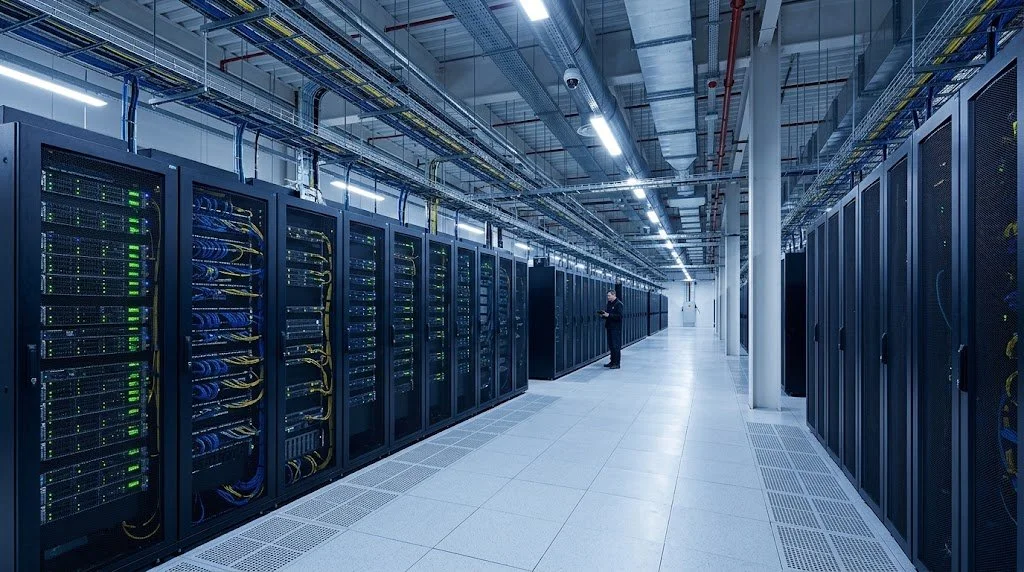
According to Bain & Company’s latest Global Technology Report, the artificial intelligence industry will need to generate $6 trillion in annual revenue by 2031 simply to justify the capital being poured into global data centres, chips, and power grids.
To put $6 trillion in perspective: if you take the combined 2025 revenues of Amazon, Apple, Alphabet, Microsoft, Meta, Nvidia, and Dell, you reach roughly $2.2 trillion. The AI sector is expected to produce nearly triple the entire annual top-line of Big Tech combined—in just five years.
Compare that target to where the market actually sits today. OpenAI’s annualised revenues hover just over $70 billion. Anthropic recently reported revenues of roughly $47 billion. While those are impressive growth curves for young software companies, they represent a drop in the ocean against a $6 trillion requirement.
Even Bain’s generous projections admit that existing consumer subscriptions and enterprise software tools will only produce between $1.2 trillion and $1.8 trillion by 2031.
That leaves a staggering $4.2 trillion shortfall. So where on earth is the rest of that revenue supposed to come from?
The standard commercial answers fail the basic arithmetic test:
Raising token prices? That ship has sailed. The influx of low-cost, high-performing open-weight models from labs like DeepSeek has potentially started a race to the bottom on API costs. Compute is being commoditised, not monopolised.
Chatbot advertising? OpenAI and others are leaning into conversational ads, but Bain estimates this will add at most $100 billion to $200 billion. It's a rounding error against a multi-trillion-dollar gap.
Replacing human payroll? White-collar efficiency gains and corporate workforce reductions can only carry the balance sheet so far before enterprise buyers hit budget ceilings and demand limits.
If software productivity gains cannot close a $4.2 trillion gap, the revenue has to come from the physical world.
The industry is no longer betting on software; it is betting on the complete automation of physical industry. The bulk of that $4.2 trillion gap relies on entirely unproven sectors: autonomous vehicles, drone logistics, and industrial robotics taking over manufacturing and supply chains ($400 billion to $900 billion), alongside speculative breakthroughs in AI-directed drug discovery, material science, and clean energy generation.
As Bain’s analysts noted, funding this infrastructure sustainably requires AI to physically add roughly 1% to the annual global GDP growth rate.
Infrastructure is running years ahead of real-world demand. If AI cannot cure diseases, rebuild supply chains, and operate the physical economy within five years, the math behind this data centre gold rush collapses under its own weight.
