
The Yandex Blackout Myth: Why Physical Strikes Barely Dented Russia's Bot Army
When Ukrainian drones struck three of Yandex's primary Russian data centres last week-hitting facilities in Sasovo, Kaluga, and Vladimir-the immediate online reaction was euphoric.
Within 24 hours, viral posts were circulating across Reddit and X claiming that the Russian state's political bot armies had finally gone dark. European politicians pointed to apparently quieter social timelines, commentators claimed toxic reply sections had vanished, and a graph showing a 99% collapse in automated requests from Yandex's network was held up as smoking-gun proof that social media had just been cleansed.
It was a neat, satisfying narrative. It was also almost entirely wrong.
Crawlers vs. Troll Farms: The Conflation Error
The chart that went viral came from edge monitors tracking automated HTTP requests on Yandex's primary autonomous system network (AS13238). Automated traffic on that specific network did indeed collapse from around 88% down to fractions of a percent.
Those were search engine crawlers and web scrapers, and unfortunately not social media bots.
Yandex operates as the Google of Russia. Its automated bots (like YandexBot) index millions of external websites daily. When physical power lines, cooling units, and server racks in Sasovo were damaged, the search spiders indexing external web servers stopped pinging.
That is an infrastructure failure for a domestic tech giant, not the silencing of a political troll farm.
The Uncomfortable Data: 45% Still Automated
A recent breakdown shared on Reddit highlighted the underlying network reality.
Despite three massive facilities going offline, broad traffic telemetry shows that automated bot traffic originating from Russia still accounts for roughly 45% of all web traffic leaving the region. The overall baseline barely budged.
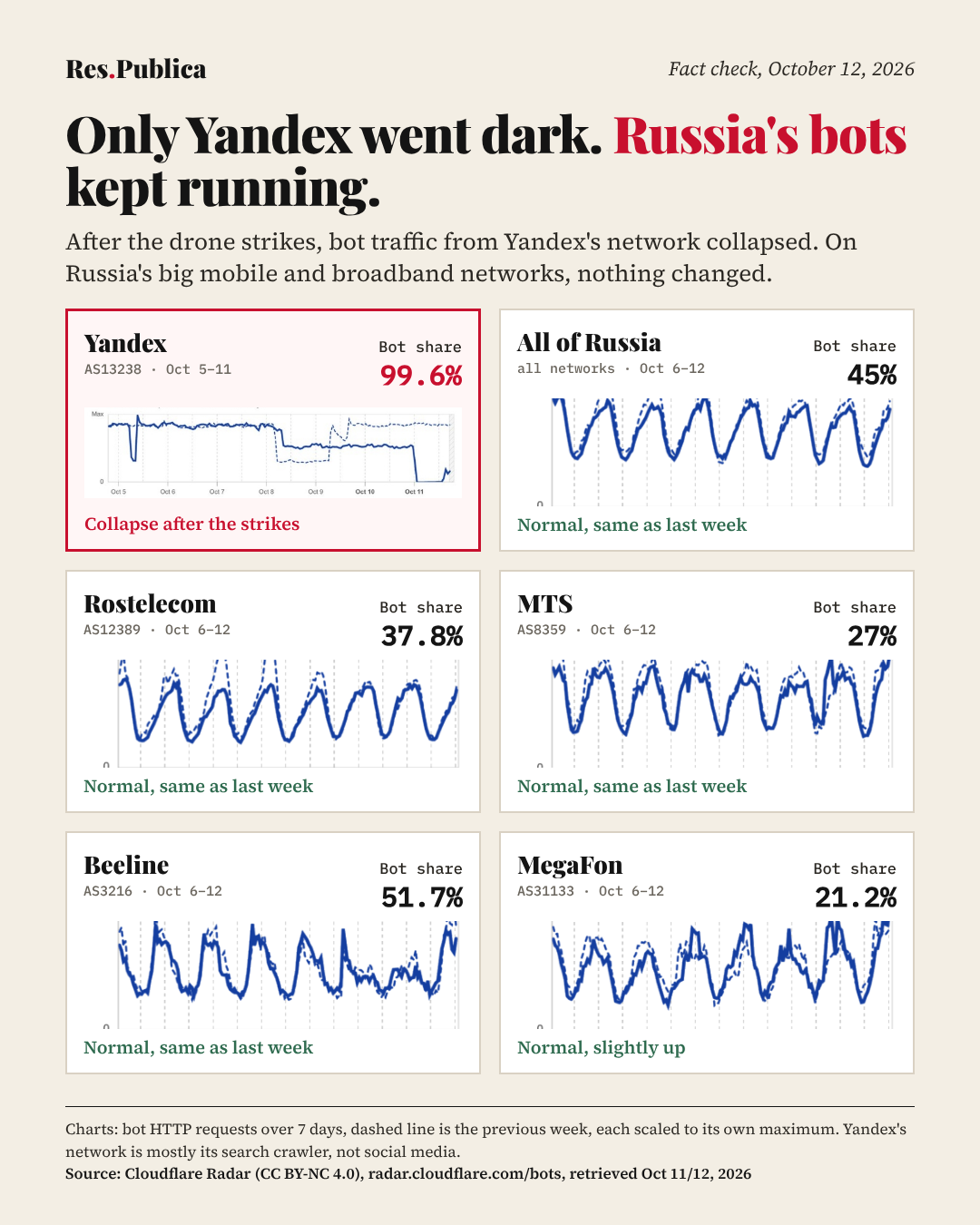
If three state-of-the-art data centres were taken out and automated traffic still sits near half of total volume, it exposes two glaring truths:
1. The anecdotal "drop in bots" was pure confirmation bias. When people are told a bot network has been shut down, they read social feeds differently. Mild disagreements feel normal again, and incendiary comments feel fewer and farther between-even when posting volume remains statically flat.
2. We fundamentally underestimate how modern influence operations are built.
Why You Can't Bomb a Bot Farm Out of Existence
No competent intelligence service or commercial astroturfing outfit runs automated influence campaigns directly off the public IP blocks of a domestic search engine. Doing so would make their traffic trivial to block at the platform firewall level.
Modern coordinated operations rely on decentralized, layered architectures:
Residential Proxy Networks: Traffic is routed through millions of compromised home routers, smart TVs, and IoT hardware situated inside Western countries, making bot requests look identical to ordinary residential users in London, Berlin, or Chicago.
Commercial VPN Pools & Leased VPS: Scrapers and posting scripts are hosted on cheap, geographically diverse virtual private servers scattered across neutral jurisdictions, completely isolated from Russian domestic clouds.
Micro-Agent Automation: Automated accounts do not sit in a single server farm executing synchronous API calls. They run through distributed browsers mimicking human cadence, click behaviour, and typing delays.
Yandex's data centres house commercial search algorithms, AI supercomputers, taxi-dispatch backend engines, and cloud storage. They are critical to domestic Russian tech infrastructure, but they are not the nervous system of global social media manipulation.
The Unfortunate Truth
The desire for a simple, tangible defeat of online toxicity is understandable. We want to believe that if you hit the right server room, the internet will return to civil debate. It’s a shame then that state-sponsored digital manipulation cannot be solved that easily!
The data proves that this is a fantasy. With automated requests still commanding nearly half of outgoing traffic from the region, the architecture behind automated noise is far too resilient, decentralized, and deeply embedded across global infrastructure to be wiped out by an outage.
If we want to understand the scale of the digital battlefield, we have to stop reading search engine crawler statistics as geopolitical victories and start facing the data as it actually is.
