
The Budget-Limit Trap: Why Your Google Ads Targets Need an Immediate Audit
If you have Google Ads campaigns marked as "Limited by budget" that are currently beating their targets, you face an immediate threat to your campaign profitability.
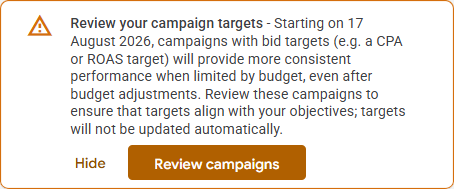
Starting 17 August 2026, Google is changing how target-based bidding systems—specifically Target CPA and Target ROAS—behave when campaigns run into budget limits. Currently, when a campaign is restricted by daily spend, the algorithm is forced to cherry-pick only the most efficient, high-intent traffic. If your Target CPA is set to £10, but your restricted budget forces this selective bidding, your actual CPA might sit at £5.
Previously, you could leave that £10 target in place and benefit from the £5 reality. From August 17, that cushion disappears. Google's bidding systems will now optimising more consistently toward the exact target you entered, regardless of your budget restrictions. In that scenario, your actual CPA will trend upward from £5 to the less efficient £10. Google will actively bid less efficiently to match your stated setting.
This update requires manual intervention. To protect your profit margins, you must align your campaign targets with actual performance from the last 30 days. Google will not make these adjustments for you.
Google is releasing a Bid Target Adjustment Tool to help manage this transition. Use this tool to audit your budget-limited campaigns. If a campaign consistently achieved a 400% ROAS over the last month but has an outdated target of 250%, manually update that target to 400%. Setting targets to mirror recent actual delivery ensures the algorithm maintains your current efficiency instead of relaxing its parameters to match an old setting.
Once updated, monitor the campaigns closely but avoid making further structural edits for two weeks to allow the bidding models to settle.
Read more detail here on Google’s update page: https://support.google.com/google-ads/answer/17061251?hl=en#:~:text=After%20August%2017%2C%20the%20changes,your%20performance%20efficiency%20unexpectedly%20fluctuating.
