
Beyond Google: Why Your 2026 Search Strategy Needs GEO
The digital landscape is fracturing. For two decades, the playbook for online visibility was simple: optimise your website for Google, climb the rankings, and watch the traffic arrive.
Today, that model is no longer enough. With platforms like ChatGPT surpassing 900 million weekly active users and Google AI Overviews appearing in over a quarter of all searches, user behavior has fundamentally evolved. People are no longer scanning a list of ten blue links. They are asking complex questions and letting artificial intelligence synthesise the answer for them.
Gartner previously predicted a 25% drop in traditional search volume, and we are seeing that structural shift play out in real time. If an AI platform answers a user query directly on the screen, the user has no reason to click through to your website.
To survive this zero-click era, brands must transition from traditional Search Engine Optimisation to Generative Engine Optimisation.
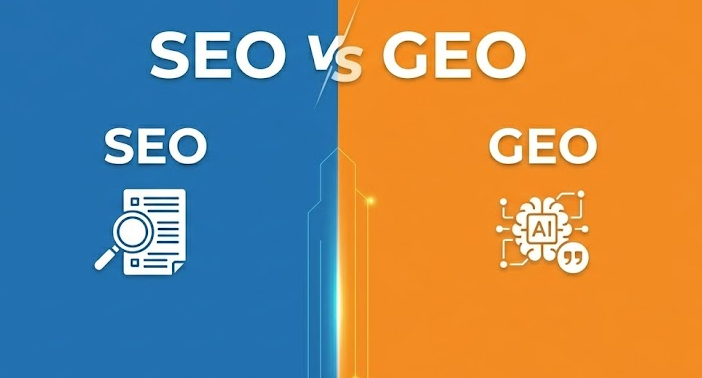
What is Generative Engine Optimisation?
Where traditional optimisation pushes your website up the search engine results page, generative optimisation ensures your brand is woven into the actual answers, summaries, and recommendations generated by engines like ChatGPT, Perplexity, and Gemini.
The competitive arena has officially shifted from ranking position to citation rate. If the AI doesn't mention your brand name or link to your site as a source, you effectively do not exist to that user.
Surprisingly, the data shows that AI citation logic has decoupled from standard search rankings. Recent studies reveal that fewer than 40% of AI citations come from pages ranking in Google top ten results. Instead, these models prioritise information that is easy to extract, highly structured, and deeply trusted.
How to Optimise for Generative Engines
To ensure your brand becomes the trusted source that AI systems choose to reference, your content strategy needs a structural overhaul.
1. Shift from Keywords to Entities
Generative optimisation requires entity authority. AI models organise knowledge by entities, which means specific concepts, products, or technologies.
Instead of chasing generic search terms, you need to build deep topic clusters around the core concepts your business wants to be known for. You must establish your brand as an undisputed topical expert across your website, socials, and third-party mentions so the AI can clearly map your niche.
2. Structure Content for Extraction
AI engines use a process called Retrieval-Augmented Generation to scan the web, pull relevant passages, and synthesise a response. If your content is buried under paragraphs of fluff, the crawler will skip it.
Lead with the Answer: Address the core question within the first 200 words of your page.
Use Clear Headings: Structure your content with a logical hierarchy using descriptive headings that pose natural questions.
Write for Scannability: Use short sections, bold key insights, and format lists using bullet points. Pages featuring structured data, lists, and direct statistics see a massive lift in AI visibility.
3. Optimise for Fan-Out Queries
When a user asks an AI a highly specific, long-tail question, the system breaks that question down into smaller sub-queries, known as fan-out queries, and searches for each one separately.
Your content needs to address these granular sub-queries. Think about the specific decision points your audience faces and write short, concise answers tailored to those micro-intents.
A final sense check: Some businesses are accidentally blocking AI crawlers through their security configurations. Review your server logs and ensure your configuration does not automatically shut off traffic from user agents like ChatGPT-User. If the crawler cannot read your HTML, you cannot be cited.
Visibility in the Future
At BOND Digital, we look at the changing search landscape with a focus on real-world impact. Traditional organic traffic may be changing shape, but the traffic originating from AI referrals is showing significantly higher conversion intent.
The shift to generative optimisation is not about replacing your existing digital marketing infrastructure, nor is about completely ditching your existing search strategy. It is about adding a layer of semantic clarity to everything you produce.
If you want to protect your digital visibility for the future, then you have to start building factually dense, authoritative source pages that are easy for an intelligent machine to quote and impossible for your competitors to replicate.
