
The August Spam Fallout: Why Chasing Search Volume Over Value Destroys Domains
Search queries for terms like "ranking drops" a have surged to all-time highs across the UK on Google Trends in recent months. It’s clear that we’re starting to see the impacts of AI’s impact on SEO.
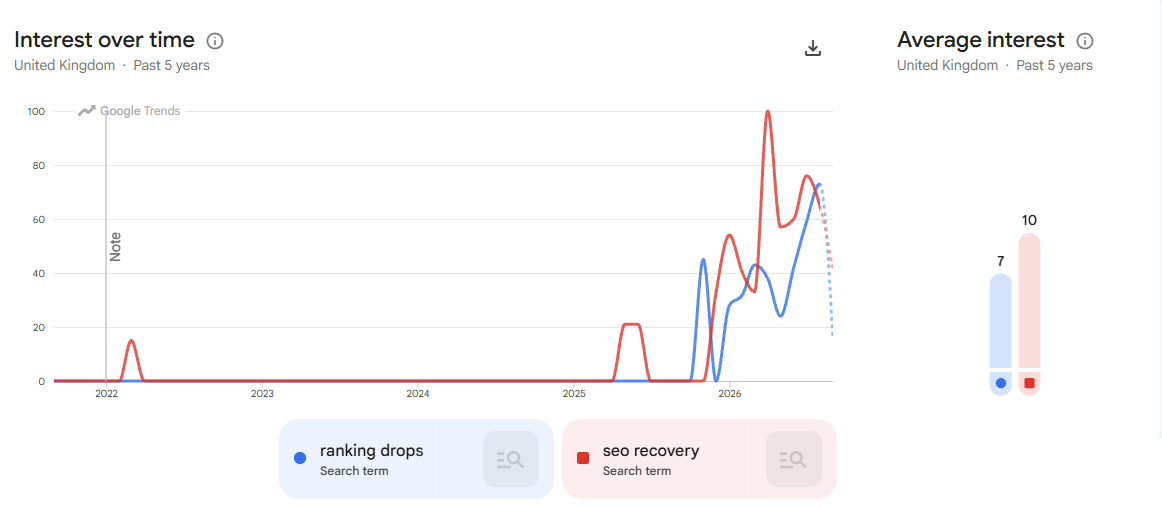
ooof
Google's August spam update finished rolling out on the 21st August, and has already made itself known.
An analysis of four wiped-out domains broken down by SEO consultant Glenn Gabe - and highlighted in Edward Sturm’s video breakdown - reveals a consistent pattern. The algorithm targeted sites guilty of scaled content abuse, thin programmatic pages, and generic affiliate setups padded out with raw AI output.
The damage was immediate and structural:
The YMYL content farm: An ultra-sensitive Your Money Your Life website lost over 200,000 ranking queries in days after pairing programmatic page generation with unreviewed AI text.
The thin affiliate directory: A massive programmatic affiliate hub pulling Amazon data without original images, hands-on reviews, or comparisons saw its visibility collapse, with bottom-of-page text flagged as 100% synthetic filler.
The massive scaled aggregator: A domain housing over 1.5 million programmatic pages was dragged down sitewide, proving that adding a thin layer of user-generated content cannot protect a site from domain-level spam penalties.
The common denominator across every casualty is an obsession with volume over actual substance.
For two years, the prevailing advice across opportunistic SEO communities was that programmatic generation and cheap AI copy could easily capture thousands of long-tail search queries. Brands spun up hundreds of thousands of low-effort pages, convinced that casting the widest possible net was the best way to dominate search engine results.
Google’s systems are actively disproving that theory.
Spam penalties act at a domain-level threshold. When an algorithm determines that the majority of your indexed URLs provide no incremental value beyond what is already found across the web, your entire domain pays the price. Legitimate content gets wiped out alongside the programmatic filler.
Recovering from these algorithmic updates is brutal. Documented recoveries, like those tracked by Lily Ray, take roughly five months of aggressive manual remediation, stripping away hundreds of thousands of low-value pages, cleaning up site architecture, and proving genuine intent before search engines begin restoring trust.
Building search visibility on volume alone has never really been a viable long term strategy. If a page exists only to capture a search term without providing original research, distinct proprietary data, or hands-on expertise, it is a liability. Focus on delivering genuine, conversion-focused answers rather than scaling empty pages.
