
70% to the Moon: Visualising the AI Spending Gap in 2026
Sam Altman and Vinod Khosla have just proposed a radical restructuring of the American tax code. Their logic? AI is going to do so much of the work that labour income will effectively disappear, necessitating a tax on capital and AI itself to fund a universal basic income.
It’s a bold vision of a post-labour future. But at BOND Digital, we’re looking at the data for 2026, and we see a very different "elephant in the room."
While the tech elite are planning for an economy broken by AI’s overwhelming success, the current reality is that AI hasn't even begun to move the needle on national productivity. In fact, the most immediate threat to the economy isn't that AI will do all the work - it's that we're spending an unimaginable amount of money on a promise that hasn't arrived yet.
The $2.5 Trillion Question
By the end of this year, worldwide spending on AI is projected to reach $2.5 trillion.
It’s a number so large it’s hard to visualize. Try this: if you stacked 2.5 trillion one-dollar bills and stood on top of them, you’d be over 70% of the way to the moon.
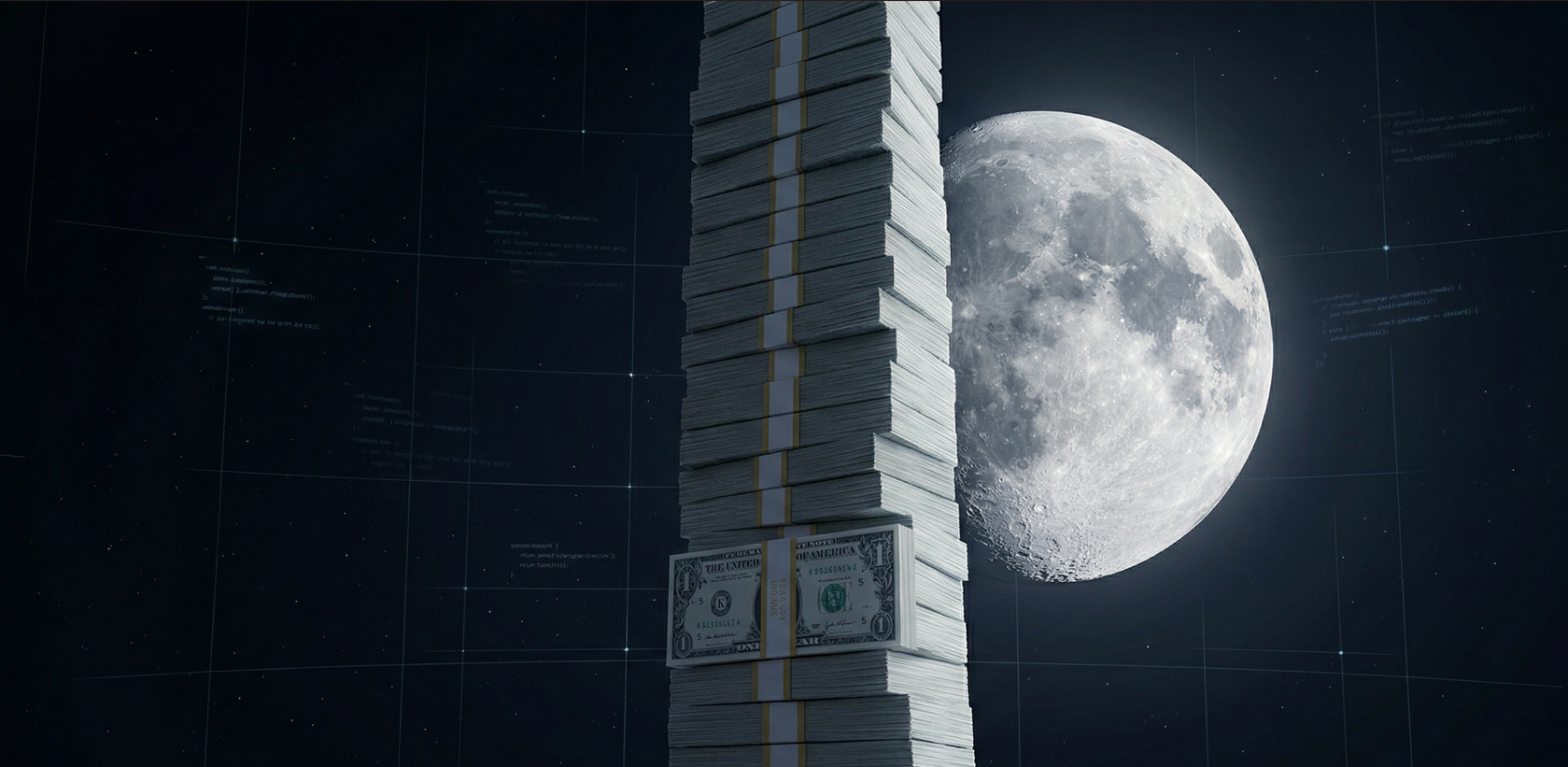
That is a staggering amount of capital currently being "shot into space." Investors and enterprises are pouring trillions into GPUs, data centres, and LLMs. But as we’ve seen from recent Goldman Sachs and NBER data, this investment has resulted in basically zero impact on US economic growth or broad-scale productivity so far.
The Bubble vs. The Breakthrough
Altman’s view is that AI will break the economy by becoming too productive. Our view is more pragmatic: the economy is at a much greater risk of being broken by an AI bubble burst.
For this $2.5 trillion investment to make sense, AI needs to start generating massive, tangible returns - not just in the form of cool demos, but in actual revenue and cost savings that show up in the GDP. Right now, there is a massive gap between the cost of the technology and the value it's creating.
We aren't seeing the mass labour displacement that would justify a total overhaul of the tax code. Instead, we’re seeing a lot of firms playing with AI while their core productivity metrics stay flat.
ROI Before Revolution
We love the vision of a post-work society, but we live in the world of the here and now.
AI has a massive amount of work to do just to break even for investors, let alone crash the labour market. The real risk for 2026 isn't that you'll lose your job to a bot - it's that the astronomical spending on AI will fail to deliver the expected returns, leading to a market correction that could shake the global economy.
Before we rewrite the tax code for a post-AI world, we need to see AI actually do the job it was hired for: making businesses fundamentally more efficient. Until then, the focus shouldn't be on how to tax the AI windfall, but on how to ensure your AI investment isn't just a pile of dollar bills aimed at the moon.
